
Provided by the Carolina Abecedarian
Project
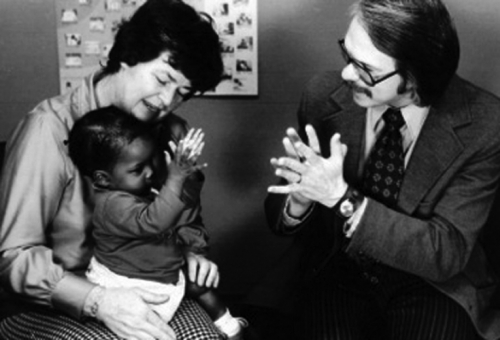
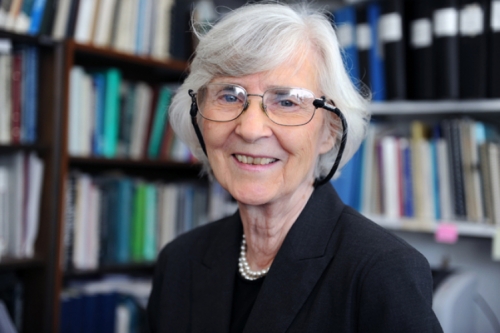
When Frances Campbell joined the Abecedarian Project in 1972, she wondered whether this was really going to work.
The plan: find infants from families with low incomes, little formal education, and other disadvantages. Give the babies full-time, quality child care. There they would get the mental stimulation and close interaction with a caregiver that researchers hoped would set them up for academic success later.
Campbell, a clinical psychologist, was hired to evaluate the babies’ intelligence as they went through the program. That sounded fine to her: she loved babies, and she knew how to do intelligence tests on people of all ages. But she wasn’t as ready as some of her colleagues to believe that changing children’s environment in the early years could permanently raise their IQs.
“I believe in genetics,” she warned Craig Ramey, the study’s lead researcher. “Do you really want somebody like me to work for you?”
Ramey just laughed. “I’ll take my chances,” he said.
They all did. The Abecedarian Project began.
One of the problems with school is that it comes too late for some children. More and more researchers are drawing this conclusion now, but even in the 1960s, evidence had come in that working intensively with high-risk preschoolers wasn’t enough to catch them up to their peers.
A few studies had suggested that babies and toddlers who got early education did better in school later—repeated fewer grades, were more likely to finish high school. In one study, early education seemed to raise the children’s IQs by 20 points on a scale where the average score is 100.
“That got everyone’s attention,” Campbell says. “There was excitement in the air about what you could do to change a child’s lot in life.” Campbell wasn’t as convinced; those studies hadn’t been carefully controlled to compare the at-risk kids getting good child care to other kids from similar backgrounds.
But the Abecedarian Project was different. The researchers recruited pregnant mothers and carefully assessed a list of 13 risk factors with each one, including the family’s income, need for public assistance, both parents’ levels of education, the mother’s IQ, and evidence of problems with school in other family members. Mothers who had similar indicators of risk to their children were matched into pairs, and one mother from each pair was placed in the Abecedarian group.
The other mothers were assigned to a control group where their babies either stayed home or went to child care arranged by the family without interference from the study. (The control group received free infant formula, to make sure that the babies wouldn’t be intellectually impaired by poor nutrition.)
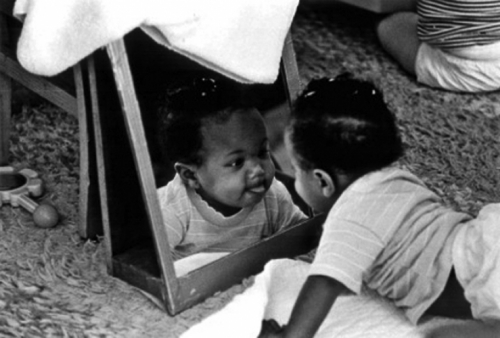
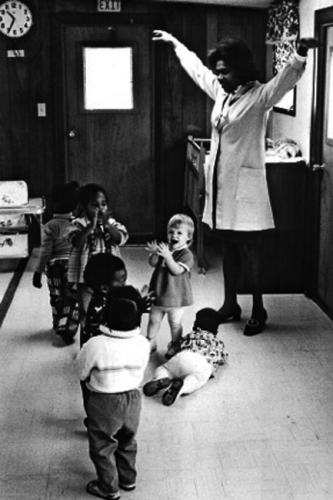
The Abecedarian group of babies got full-day care, five days a week, from infancy until they started kindergarten. The caregivers were trained in a curriculum called LearningGames by Joseph Sparling and Isabelle Lewis, designed to develop kids’ cognitive, social, language, and perceptual-motor skills. The word “games” is sort of misleading; a game might be explaining the meaning of a word to a child, or playing with a baby in front of a mirror so he can see himself having fun. The main goal was to help the children develop language skills, Campbell says, because that’s the foundation of future success in school.
If this sounds less like a curriculum than a parent just paying good attention to a child, that’s pretty close to the truth. Sparling described LearningGames as not much different from “good adult-child interaction,” which can be in short supply when daycares have many kids and few caregivers. The ratios of children to adults in the Abecedarian Project were comparatively good: three babies to one caregiver, increasing to six children per caregiver when the kids were almost school-aged.
When Abecedarian began, Campbell was 39; she still had two kids at home and was looking for something to do part-time. She started out assessing the development of three-month-old babies. The original study was to evaluate the children until age three; since the team was working from grant to grant, no one knew for sure how long they’d be able to monitor the group.
Those first years for Campbell were full of talking to babies, seeing how they responded to her chatter and to objects in front of them. “With a baby, you’re looking at stuff that isn’t ‘intellectual,’ but you can see who’s coming along on track,” Campbell says. “You can tell things about alertness, responsivity, reaction times. Not every baby reacts to what’s going on in the environment.”
At six months, there were already small mental differences between the Abecedarian babies and the control group. The gap grew throughout toddlerhood, and at age three it reached its maximum of an 18 IQ-point difference between the Abecedarian and the control-group kids. When the kids reached school age, the gap started to narrow.
Campbell isn’t comfortable saying that higher IQ scores mean the Abecedarian kids were smarter, exactly. The term IQ has been so widely misunderstood that she doesn’t even like using it anymore; she prefers “test performance.” Some people have argued that IQ tests are cultural constructs that don’t objectively compare people on some innate mental capacity. And that’s true, Campbell says. IQ tests weren’t designed to give a full picture of a person’s mental abilities; they were designed to predict school performance. “They do that job well,” she says. And school performance is exactly what the Abecedarian researchers were interested in improving.
As the Abecedarians moved through school, they were tested repeatedly for IQ, reading skills, and math performance. The Abecedarian group’s scores were always higher, although the gap between the two continued to narrow.
While the team was studying data from the 15-year-olds, Craig Ramey, the lead researcher, left UNC. Campbell, now heavily involved in running the studies, had long ago handed off the intelligence testing to other evaluators. She knew the kids too well. She knew who was in the day-care program and who wasn’t, and she didn’t want any bias she had to interfere with the results. When Ramey left, Campbell took over the lead role in the study.
She watched the IQ test data coming in. “I really expected it to converge by 21,” she says. “That’s not to say anything bad about either group of kids.” It’s just that impressive data tends to get less impressive as you keep gathering more; it’s an old phenomenon statisticians call regression toward the mean. What looks at first like a striking result can turn out to be just chance.
But when the Abecedarians reached 21 and had their final adult IQ test, they were still about four points ahead of the control group—a small but significant difference. Even Campbell was convinced, and she called up Ramey right away to tell him. “He sure showed me,” she says.
Now grown up, the Abecedarians turned 30 in the 2000s. They weren’t IQ tested this time—the participants have spread out around the country, and it’s expensive and time-consuming to continue evaluating them—but they still seem to be getting the benefit of their early education. Twenty-three percent of Abecedarians have graduated from college, compared to only six percent of the control group. More of the Abecedarians are employed full-time—75 percent versus 53 percent of the control group.
Abecedarians are much less likely to have spent a significant amount of time receiving public assistance. But they aren’t much different from the control group in terms of income relative to their family needs or the number of criminal convictions they’ve had.
Campbell still closely guards their identities. Many of the Abecedarian kids-turned-adults are still in the area. Sometimes she sees them in the street. Some she recognizes; others look too grown-up to be the same people as the children she remembers. When she sees the mothers from the studies, it’s usually a happy meeting—they talk, catch up on how the kids are doing. “It feels like family to me,” she says. “If you meet someone when they’re an infant, you still care about them.”
Campbell is 79 now, and too interested in the Abecedarians to think about retiring. The team is still analyzing data from ages 21 and 30, and planning an age 40 follow-up. But in Campbell’s mind, the mission of the project is accomplished. “We answered the question,” she says. “Yes, you can make a difference for these kids.”
Frances Campbell is a senior scientist at the Frank Porter Graham Child Development Institute. Other Abecedarian researchers include Research Professor Margaret Burchinal and Research Assistant Professor Elizabeth Pungello, both from the FPG Institute, and Barbara Wasik, a William R. Kenan, Jr., Professor in the School of Education. Joseph Sparling, formerly a senior scientist at the FPG Institute, is retired from UNC.
The Abecedarian Project was funded by the U.S. Department of Health and Human Services’ Maternal and Child Health Bureau, the U.S. Department of Education’s National Institute on Early Childhood Development and Education, and the David and Lucile Packard Foundation.