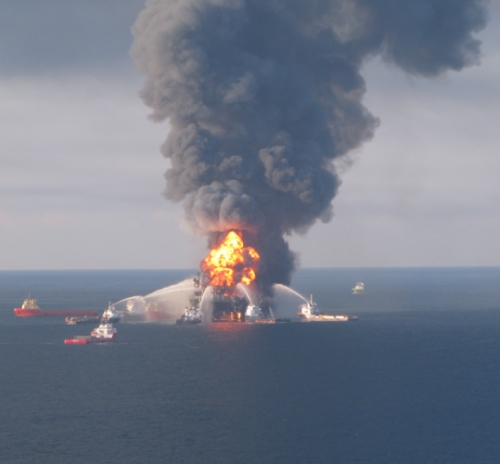
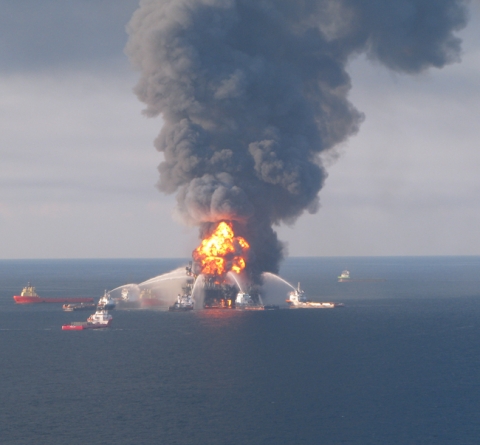
On July 29, 2010, Time magazine ran a story with the headline, “The BP Spill: Has the Damage Been Exaggerated?” Research from UNC and elsewhere shows that Time could’ve run a sidebar: “The BP Spill: Is It Too Early to Assess the Damage?”
When BP’s Deepwater Horizon oil rig failed on April 20, 2010, nearly five million barrels of oil and gas gushed into the Gulf of Mexico. Weeks later, oil washed ashore, killing wildlife and contaminating estuaries and beaches.
But the immediate aftermath was nowhere near as horrific as scientists and environmentalists had feared. In the past, much less oil had caused much more damage. In 1989, for instance, the Exxon-Valdez spilled less than one million barrels of crude oil off the coast of Alaska, killing hundreds of bald eagles, thousands of otters and seals, hundreds of thousands of seabirds, and billions of fish eggs. The carnage following the BP spill didn’t seem to compare.
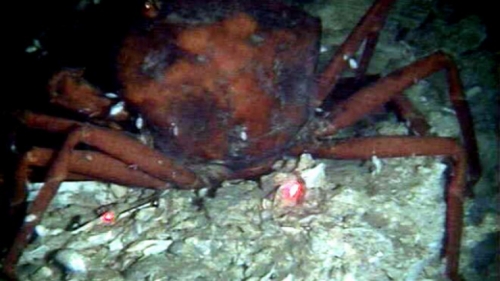
Photo Credit: Samantha Joye
December 2010: a dead crab covered in oil residue ten miles from the BP wellhead.
Click to read photo caption. Photo Credit: Samantha Joye
But the BP-Deepwater Horizon spill was 41 miles off the Louisiana coast and began from a wellhead 5,000 feet below the surface. A lot of marine life under water was affected but not seen on the nightly news in July 2010. Also, 40 percent of the spill wasn’t oil; it was toxic gas that was much harder to track once released into the water column.
There’s never been a spill like it, says Andreas Teske, a microbiologist at UNC who’s been studying the effects of the spill with Samantha Joye from the University of Georgia and Carol Arnosti and Chris Martens from UNC’s Department of Marine Sciences and Institute of Marine Sciences. They found that much of the oil and gas never made it to the surface, never made it to shore, but still has had a huge environmental impact.
Joye, who earned her undergraduate and doctoral degrees from UNC, had been to the seafloor near the BP wellhead many times before the oil spill to take core sediment samples. Four months after the well was capped, she and Teske returned to the Gulf on a National Science Foundation grant. About two miles from the BP wellhead, all seafloor samples were covered in a brownish muck a couple inches. “But it wasn’t fresh crude oil,” Teske says. It was a kind of accumulated necromass—toxic petroleum byproducts mixed with dead organisms. “Whatever lived at the floor has been run over by this toxic sediment,” Teske says.
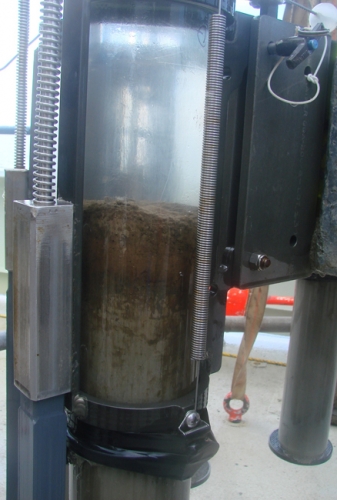
Photo Credit: Samantha Joye
When Andreas Teske and Samantha Joye collected samples from the Gulf of Mexico seafloor, they noticed a two-inch think fluffy layer of oil-based sediment. They dated it to the oil spill, and some of the sediment’s most toxic components are still on the seafloor.
Click to read photo caption. Photo Credit: Samantha Joye
Joye and Teske found dead worms, crabs, sea fans, and other sea life in similar sediment miles from the BP wellhead. Dead deepwater coral were covered with muck; they died immediately. “I’ve seen this recalcitrant oily muck at a large range of sites spanning a wide area since the oil spill,” she says, “but I had never seen anything like this before the spill.”
Teske and Joye found that the sediment contains various types of oil-degrading bacteria, and other researchers found that the same sediment samples contained heavy petroleum compounds that microbes weren’t able to digest. Many of the nastiest compounds—polycyclic aromatic hydrocarbons—are well-known carcinogens and are likely still in that brownish muck at the bottom of the Gulf because they’re hard to degrade, Teske says.
Oil and volatile gasses contain two other groups of compounds—alkanes and aromatic hydrocarbons. Many alkanes can be degraded by specialized bacteria, yeast, and fungi. “They’re the only life forms that can consume oil,” he says, “and incorporate it into their own biomass or process it into less harmful molecules.”
And bacteria did consume alkanes and aromatics during and after the 2010 oil spill, but there weren’t enough microorganisms to eat all the hydrocarbons, Joye says. Many oil compounds remained in the water column long enough so that marine life ingested them or bacteria ate them, Teske says. Zooplankton eat bacteria. Shrimp eat zooplankton. Fish eat shrimp. Larger fish, dolphins, and seabirds eat smaller fish.
Teske Lab
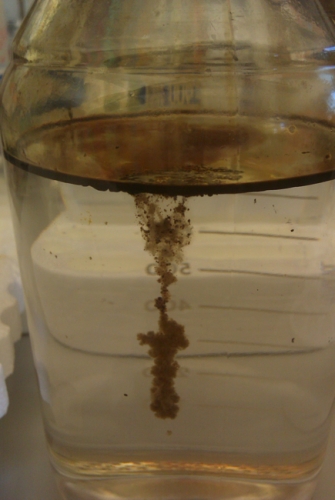
After the BP oil spill, oil mixed with tiny organisms to create what Andreas Teske calls marine snot. Between 12-20 inches in length, the globs eventually sank to the seafloor where they remain. Teske’s team at UNC recreated the globs in his lab by adding crude oil to marine water, which is naturally full of plankton and bacteria.
Click to read photo caption. Teske Lab
The carcinogenic oil compounds, especially polycyclic aromatics, that cause mutations in marine life gradually percolated through the food chain. These effects wouldn’t have been evident immediately after the oil spill, Joye says. Even after the Exxon-Valdez accident in 1989, Alaskan herring fisheries didn’t collapse until two years later.
This year, commercial shrimpers on the Gulf have reported catching tons of shrimp and crabs that have no eyes. Researchers and commercial fishers who had never caught deformed fish have now documented catching many sickly fish with visible sores, toxic livers, and malformed hearts.
“I wish I could say that the oil spill is not a long-term problem because the Gulf system is primed to handle oil spills,” Joye says. “But that’s just not the case. Only now are we beginning to see some of the long-term impacts.”